Main overview · Check a licence · Age and ID checks · Complaints and disputes
UK Casino Data Security Checks and Account Privacy Rules
 Available in US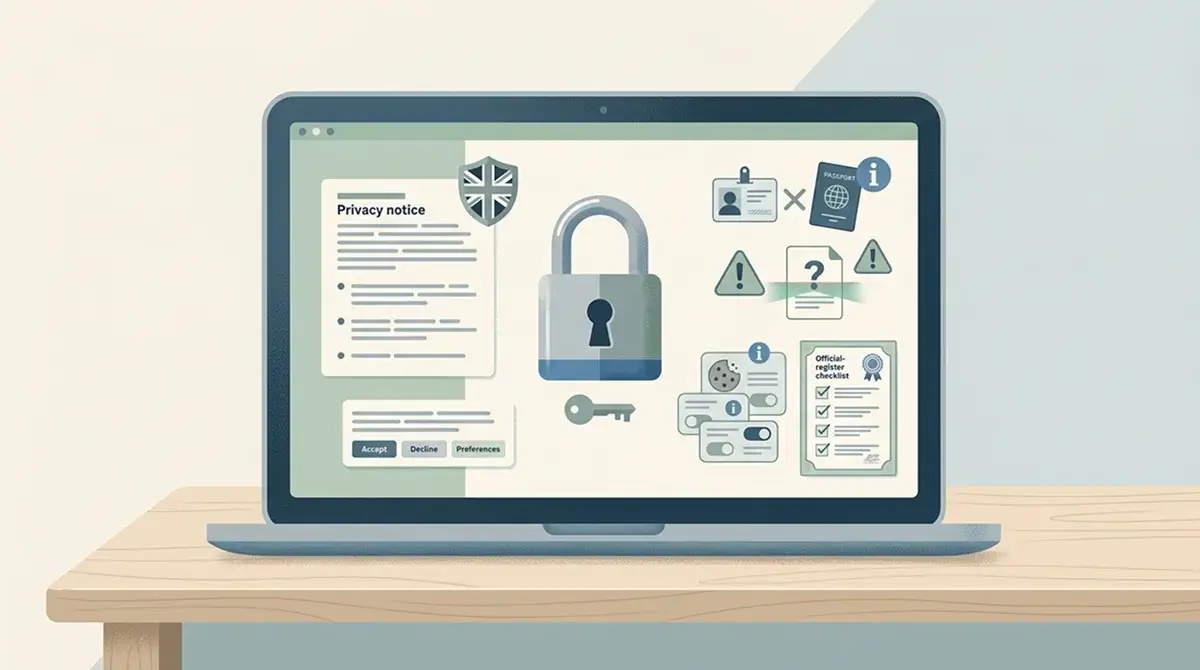
Table of Contents
- Verifying UK Casino Business Integrity and Security Features
- What a clear privacy notice should help you understand
- Privacy and security checklist
- Identity documents deserve extra caution
- Cookies and advertising data in gambling
- Account security is also your responsibility
- When to complain about personal-information handling
- Before sending any sensitive information
- Official pages worth using
- Related pages
Verifying UK Casino Business Integrity and Security Features
A privacy check is hard to do if the business behind the account is unclear. Before sending documents or payment details, look for the legal business name, trading name, licence position, contact route and privacy notice. A footer badge, a short promise or a copied-looking certificate is not enough by itself. The licence check page explains how to compare a domain, trading name and business name where a Great Britain licence is claimed.
This page does not decide whether any named site is safe. It gives a safer way to read privacy and account-security information. The useful question is not “does the site say it is secure?” The useful question is “can I understand who will receive my information, why it is needed, how long it may be kept, who it may be shared with, and how I can raise a concern?” If those basics are missing, the safest move is to pause before adding more personal information.
What a clear privacy notice should help you understand
ICO guidance on privacy information is a good benchmark for ordinary readers. A clear notice should help people understand what personal information is used, why it is used, lawful basis information where relevant, retention, recipients, rights and complaint routes. The wording should be accessible enough for a user to make a practical decision, not hidden behind vague legal language.
For a gambling account, focus on the parts that affect real risk. Does the notice explain identity checks and document handling? Does it describe payment and fraud checks in understandable terms? Does it say anything about marketing, profiling, cookies or advertising partners? Does it give a way to complain about personal-information handling? Does it match the business name and domain used by the gambling account? If the notice is generic, unfinished or disconnected from the account you are using, treat that as a warning sign.
Do not read a privacy notice as a guarantee. A well-written notice does not prove that every process is fair, and a long notice does not prove strong security. It is one piece of the check. Combine it with the licence position, account terms, document-upload route, withdrawal rules and the complaint path.
Privacy and security checklist
| Area to check | What good clarity looks like | Warning sign |
|---|---|---|
| Business identity | The business name, trading name, domain and contact route are consistent across the site, terms and privacy notice. | The site uses a badge or licence number but the business name or domain cannot be matched clearly. |
| Privacy notice | The notice explains why information is collected, how it may be used, how long it may be kept, who may receive it and what rights users have. | The notice is missing, generic, copied-looking, out of date, or written so vaguely that the reader cannot understand what happens. |
| Document handling | Identity-document requests are explained through the account process or a clearly identified official route. | Documents are requested through informal messages, unfamiliar file links or a channel that does not match the account process. |
| Cookies and advertising | The site gives clear choices and information about non-essential cookies and advertising-related data use. | Tracking or advertising cookies appear to be used without a clear choice or understandable explanation. |
| Account login | The account supports sensible login protection, and the reader uses a strong separate password and two-step verification where available. | The same password is reused, updates are ignored, or the account has no meaningful protection against unauthorised access. |
| Complaint route | The site explains how to complain about personal-information handling, and the ICO route can be checked if the issue is not resolved. | Support gives only vague replies, no written route, or asks for more sensitive material without explaining why. |
Identity documents deserve extra caution
Age and identity checks can be legitimate, and the dedicated ID page explains why online gambling businesses in Great Britain must verify age and identity before gambling. Privacy caution does not mean “send nothing ever”. It means the reader should understand who is asking and why before sending sensitive material.
Be especially careful when a site first gives a low-friction impression, then asks for passport images, bank statements or other sensitive material only after a withdrawal. A later request may sometimes have a real reason, but it should still be clear, proportionate and tied to the account process. If the route is unclear, keep records, ask for a written explanation and avoid sending repeated copies through different channels.
Do not change personal details, use another person’s information or search for ways to avoid matching. If self-exclusion, a bank block or an account review is stopping gambling, that is a protection issue. The safer response is to use the self-exclusion and help pages, not to test another route with more personal data.
Cookies and advertising data in gambling
Cookies can be used for basic site functions, but they can also be connected to advertising and profiling. In a gambling setting, that distinction matters because marketing can reach people at moments when they are already tempted to continue playing. The ICO has taken action in a gambling-cookie case involving cookies used without proper consent. That example does not prove anything about every gambling site, but it shows why cookie and advertising-data wording should not be dismissed as harmless small print.
A practical reader check is simple. Is there a clear cookie notice? Can non-essential cookies be refused as easily as accepted? Does the explanation separate necessary cookies from advertising or analytics uses? Does the privacy notice explain marketing choices? If the site treats every tracking choice as automatic, or makes refusal difficult to understand, that is a reason to slow down before opening an account.
Account security is also your responsibility
The National Cyber Security Centre gives practical advice that applies well to gambling accounts: use strong separate passwords, keep devices and apps updated, use two-step verification where available and consider a password manager. These steps do not make a gambling site trustworthy, but they reduce the risk that an account is compromised because of avoidable habits.
Separate passwords matter because gambling accounts may connect money, identity documents and personal contact details. Reusing the same password from email, shopping or social accounts can make one breach affect several parts of life. Two-step verification is also useful where the site offers it, especially if the account contains payment details or document-upload history.
Security language from a gambling site should be treated carefully. Do not assume that a padlock icon, a “safe payments” phrase or a long list of technical words proves fair handling. Licensed remote gambling businesses and gambling software licensees must meet technical and security standards, but that is not the same as proof that a specific site, process or document request is safe for the reader in a particular situation.
When to complain about personal-information handling
If a business appears to mishandle personal information, first keep a clear record. Save the privacy notice, the account messages, document requests, cookie choices, support replies and dates. Then complain to the organisation in writing where possible. The ICO explains how people can raise a data-protection complaint and what to do if the organisation does not respond properly.
A data complaint is not the same as a withdrawal dispute, although the two can overlap. For example, a reader might have a money dispute because a withdrawal is delayed, and a data concern because documents were requested through an unclear channel. Keep those issues separate in writing. That makes it easier for the business, an alternative dispute route or the ICO to understand what happened.
Do not make unsupported accusations about criminal conduct, targeting or unlawful profiling. Say what happened, what information was requested, what explanation was given, what was unclear and what response is being requested. A precise complaint is safer and more useful than a dramatic one.
Before sending any sensitive information
- Check whether the business and domain can be identified clearly.
- Read the privacy notice, account terms and withdrawal rules together.
- Use the licence-register check if the site claims a Great Britain licence.
- Send documents only through a route that matches the account process and is clearly explained.
- Use a strong separate password and two-step verification where available.
- Do not send extra documents just because support asks informally or urgently.
- Do not use privacy concern as a reason to avoid age, identity or self-exclusion protections.
Official pages worth using
- NCSC top tips for staying secure online
- ICO guidance on privacy information
- ICO guide to making a data-protection complaint
- ICO gambling-cookie action
- Gambling Commission remote technical standards
Related pages
- Age, ID and verification checks in online gambling
- How to check a gambling site before you deposit
- What to do if a gambling account or withdrawal goes wrong
- Claims to treat carefully before using any gambling site
Created by the "Casino not on Gamstop" editorial team.